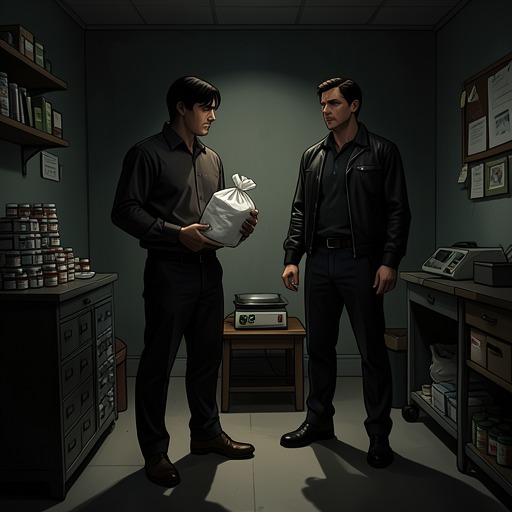
Harry and Tyrone’s two-stage briefcase drug deal
Requiem for a DreamHarry Goldfarb and Tyrone C. Love’s two-stage briefcase drug deal is a meticulously planned heroin purchase that turns ordinary public places into cover for a large criminal transaction. Its two exchanges—first at Kennedy Airport, then beside the model trains in Macy’s—show the partners’ confidence in routine, disguise, and controlled movement. Once the pound is in their hands, they process and distribute it through trusted intermediaries, while Harry treats the transaction as the final step before a retirement that the scene gives him every reason to imagine but does not secure.
The Deal’s Design and Stakes
Harry and Tyrone frame the purchase as the culmination of a business they believe they have learned to manage. While Tyrone is away, Harry passes the time listening to the radio and smoking, imagining that they will soon bag the heroin, make money, hire a couple of sellers, and eventually buy a pound of pure product. When Tyrone returns, they count the money together: seventy-five thousand dollars. They are careful about the amount because Harry knows that their contacts will not treat a mistake as an innocent error. The money is packed neatly into an attache case, locked, and taken to the airport.
Their imagined operation is both ambitious and self-congratulatory. Harry pictures a formal partnership with everything in black and white, joking about equal opportunity and imagining how far the business might go. The humor makes the enterprise sound almost respectable without changing what it is: a heroin operation that depends on concealment, trusted contacts, and the movement of a large quantity of drugs. Harry’s confidence rests on the belief that they can stay unnoticed and quit before the business turns dangerous.
That belief shapes the method. Harry says they use a Chevrolet rather than a Mercedes and divide contacts so he deals with white associates while Tyrone deals with Black associates. To Harry, blending into ordinary life is a practical safeguard: he imagines that strangers would take him for a businessman, perhaps an investment counselor, rather than a major drug distributor carrying seventy-five thousand dollars. The gap between his imagined public identity and the contents of the case becomes part of the scene’s tension.
The Airport Exchange
Harry drives to Kennedy Airport with the case beside him, keeping the music low and taking care not to attract attention. He has planned for delays, leaving time for traffic and parking rather than risking a hurried arrival. At the terminal, he first eats pie à la mode in the coffee shop, keeping the case on his lap. Then he sits in the cocktail lounge near the windows overlooking the airfield, sets the case close to his foot, and watches planes take off, land, and taxi to the ramps.
A man dressed in a coat, hat, and suit much like Harry’s sits beside him with an identical-looking case. The stranger finishes his drink before Harry has finished his, picks up Harry’s case, and leaves. Harry continues watching the planes. Ten minutes later, he picks up the case left beside him and walks out without checking whether the other man is nearby. The swap depends on their matching luggage, their unhurried behavior, and Harry’s willingness to trust that the exchange has gone as intended.
The airport is dangerous in Harry’s own assessment: it is exposed, full of police, and offers little chance to flee if a meeting goes wrong. He reasons that this is precisely why it works; a meeting in such a conspicuous place seems too unlikely to invite suspicion. Traffic, which he first treats as another risk, becomes part of the cover. On the drive away, he stays calm through snarls and flashing roadside lights, telling himself that ordinary accidents and delays have nothing to do with him. His composure is not the same as security: it depends on repeatedly interpreting possible danger as irrelevant.
Macy’s and the Second Swap
After the airport, Harry chooses a second location and a second layer of movement. He imagines that no one would suspect Macy’s, particularly its toy department, as a place for a drug exchange. On the way, a cabdriver swerves through traffic, curses other drivers, and gives them the finger; Harry remains a passenger, smiling with the case on his lap. He briefly stops at the lingerie department to look at something Marion might like, but does not buy it. In his own hierarchy of priorities, business comes first.
He rides the escalator up to the toy department and takes in the model-train display, which he had already imagined as an appealing place to meet. At the appointed time, he puts his case beside his foot. A man arrives, and they exchange cases as before. Harry leaves the store, changes direction through a sequence of walks and cab rides, and reaches the cutting room where Tyrone is waiting. The second swap completes the purchase’s staged design: the partners do not carry the money straight into a single direct meeting, but route the transaction through separate encounters and busy public settings.
Distribution and the Promise to Quit
At the cutting room, Harry presents the product as the last pound they will handle. He and Tyrone carefully cut it, bag it, and send it out through their people, who supply the street market. The partners do not deal directly with people who use drugs; they reserve their own dealings for intermediaries they consider reliable. Tyrone takes most of the product for his contacts, while Harry takes the remainder for his. Their division of labor is presented as an operating rule as well as a reflection of the separate networks they have cultivated.
When the last of the heroin is gone, the partners celebrate with their women. For Harry, the sale appears to confirm the future he has been rehearsing throughout the drive: he and Marion will leave the business, travel, and live on the money he believes he has accumulated. He recalls brief trips to the Bahamas and imagines longer stays on the Riviera and in cities such as Paris and Rome. These are his projections, not outcomes established by the deal. The case exchanges succeed and the pound reaches the street, but success at completing a transaction does not prove that Harry can control the risks or leave the trade. The episode’s decisive irony lies in the distance between his carefully managed present and the permanent retirement he treats as already within reach.